
A team sat down to compare one warehouse's stock sheet against Odoo. The sheet had extra items the system didn't. Odoo had 128 items in one section and roughly 250 in another that the warehouse said shouldn't be there — every one of them needing a return to fix. And it was the third time that month the team had received an inventory sheet that didn't match reality. That meeting is a textbook Odoo inventory reconciliation — and it shows exactly why reconciliation is rarely the real problem.
The story: one Odoo inventory reconciliation call
The recording opens with the comparison already done. The final sheet matching the warehouse's count against Odoo had been sent over Telegram, and the team walked it line by line. Most of the session was not arithmetic — it was deciding what each mismatch meant and who would fix it.
Two "brandy" items had been dispatched with no matching system transfer and no pick record: physically gone, invisible in Odoo. That became a task — one person to track down why, with the warehouse lead, before anything else closed. A "Carafe small" line showed a quantity of three; the team decided it should be two, because the three was a typing error, not a real count. Small decision, but now a decision, not a guess.
Then the heavy lifting: every discrepant item had to be walked back through Odoo with a specific returns-and-unpick procedure, demonstrated live in the call so the warehouse could repeat it. One person owned that. A wrong SKU on a "vanilla orange" product had to be re-sent and verified before its line could be trusted. And all of it carried a hard deadline — every open reconciliation issue on the Saudi Arabia account had to close that same day, because the person who understood the fixes was traveling the next morning.
By the end, the meeting had produced a dozen concrete decisions and tasks: what was wrong, what the corrected number was, who fixed it, and by when. The problem is what usually happens to those decisions after the call ends.
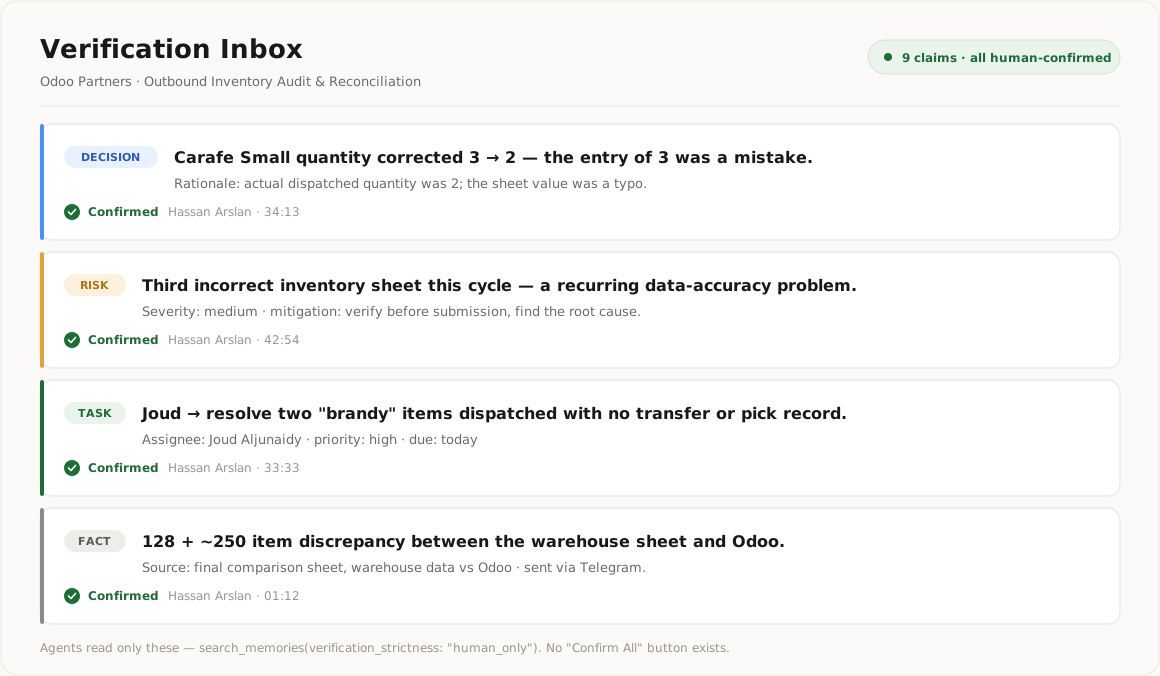
The actual claims behind this post — extracted automatically, each promoted to evidence by a named human. Nothing acts until it's confirmed.
What went wrong — and it wasn't the count
The inflection point was a single line: this was the third incorrect inventory sheet the lead had received. The reconciliation itself went fine. The recurring part is the failure — bad data arriving again and again, each round re-litigated from scratch because the last round's corrections lived only in someone's memory and a Telegram thread. The same call also surfaced a quieter cost: a team member had earlier stopped work entirely because he'd been told his output was wrong, with no clear record of what "right" was. Conflicting, unrecorded instructions don't just waste a meeting — they stall the people downstream of it.
The insight for Odoo partners
If you implement Odoo for clients, this meeting is your client's Tuesday. Physical stock drifts from the system constantly — wrong SKUs, dispatches with no pick, typos in a count sheet. An Odoo inventory reconciliation is the routine that catches the drift. But the reconciliation produces decisions, and decisions evaporate. Next month the same sheet is wrong, the same questions get asked, and nobody can say what was decided last time or whether it was ever done. The partner who only fixes the data is on a treadmill. The partner who captures the decisions — corrected quantity, owner, deadline, reason — builds a baseline each cycle starts from instead of resetting to zero.
What this means for you
Treat the reconciliation call as a source of confirmed facts, not a one-off cleanup. Record it. By the time it ends, the corrections are already extracted — the Carafe quantity fix, the two missing brandy items, the returns procedure and who owns it, the same-day deadline. The lead spends a few minutes confirming the ones that matter, and each becomes a fact with a timestamp and a named person behind it.
That record changes the next cycle. When the fourth sheet arrives, you open last month's confirmed corrections instead of reconstructing them from chat. You can see that the brandy discrepancy was assigned and whether it closed. You can prove the Carafe count was deliberately set to two, not lost. And your own tooling can read those confirmed facts directly — an automation that only ever sees human-confirmed reconciliation decisions, never an unreviewed guess. The shipped pieces today are capture, extraction into decisions, tasks, risks and facts, the per-claim confirm step, and the verified query layer. The auto-drafted Odoo correction is a roadmap target, not a demo. What exists now already ends the "which number is right, and who said so" loop that eats every recurring reconciliation.
FAQ
What is an Odoo inventory reconciliation?
An Odoo inventory reconciliation is the process of comparing what Odoo says you hold against a physical count or a warehouse sheet, then correcting the gaps. Differences come from dispatches recorded without a pick, transfers that never posted, wrong SKUs, or simple counting errors. The fix is usually a mix of stock adjustments and returns/unpicks to bring the system back in line with reality. The mechanical part is well understood. The part teams underestimate is governance: each correction is a small decision — what the right number is, why, and who applies it — and those decisions need to survive past the meeting. Without a record, the next reconciliation repeats the same investigation, which is why the same sheets stay wrong month after month.
Why does the same inventory sheet keep coming back wrong?
Because the correction and the cause get separated. A reconciliation call fixes the numbers but rarely records why each one was off or who owns preventing it next time. In the meeting behind this post, the same lead had received three incorrect sheets in a row. Each round, the corrections lived in memory and a Telegram thread, so the root cause — a process that let stock move without a system record, conflicting instructions, an untracked SKU — was never closed. The data got patched; the leak stayed open. A confirmed record of each reconciliation decision turns the recurring scramble into a shrinking list: you can see which causes were assigned, which were fixed, and which keep reappearing and therefore need a process change, not another patch.
How is this different from exporting an Odoo report?
A report tells you the numbers don't match. It does not tell you what your team decided to do about each mismatch, why, or whether it happened. Reconciliation decisions are conversation, not a column — "this three is a typo, make it two," "those two items shipped with no pick, find out why," "use this returns procedure, you own it." An export captures none of that. Capturing the call and confirming each decision gives you the layer the report can't: the corrected value plus its reason, owner, and deadline, anchored to the moment it was agreed. Next cycle you start from that confirmed baseline instead of re-deriving it, which is the difference between reconciliation as a treadmill and reconciliation as something that actually converges.
Do we have to confirm every claim from the meeting?
No — you confirm the ones that carry weight. A reconciliation call surfaces a lot; the corrections, the owners, the deadlines, and the recurring risks are what you want on the record. Trivial or off-topic items can be left or rejected. The review is one tap per claim on an already-extracted list, a few minutes after the call, not a re-watch. The deliberate rule is that there's no bulk confirm-all, because a rubber-stamped record is as useless in next month's audit as no record. The cost is small and front-loaded; the payoff is that the next reconciliation, and the one after, start from facts a named person stood behind instead of a thread nobody can find.
How does this help an Odoo partner specifically?
Your clients live this every cycle, and the reconciliation work is often billable or relationship-critical. A confirmed record of each reconciliation does two things for the partner. It protects you in disputes — you can show what was decided, by whom, and when, instead of arguing from memory. And it compounds: each client accumulates a history of corrections and the causes behind them, so you can point to the recurring leaks that justify a process or configuration change rather than endless manual cleanup. That moves the partner from firefighting the same sheet monthly to selling the fix that stops it — a stronger position commercially and a calmer one operationally.
Closing
The reconciliation will always find the gaps. Whether you fix the same gaps next month depends entirely on whether anyone can still prove what you decided this month.